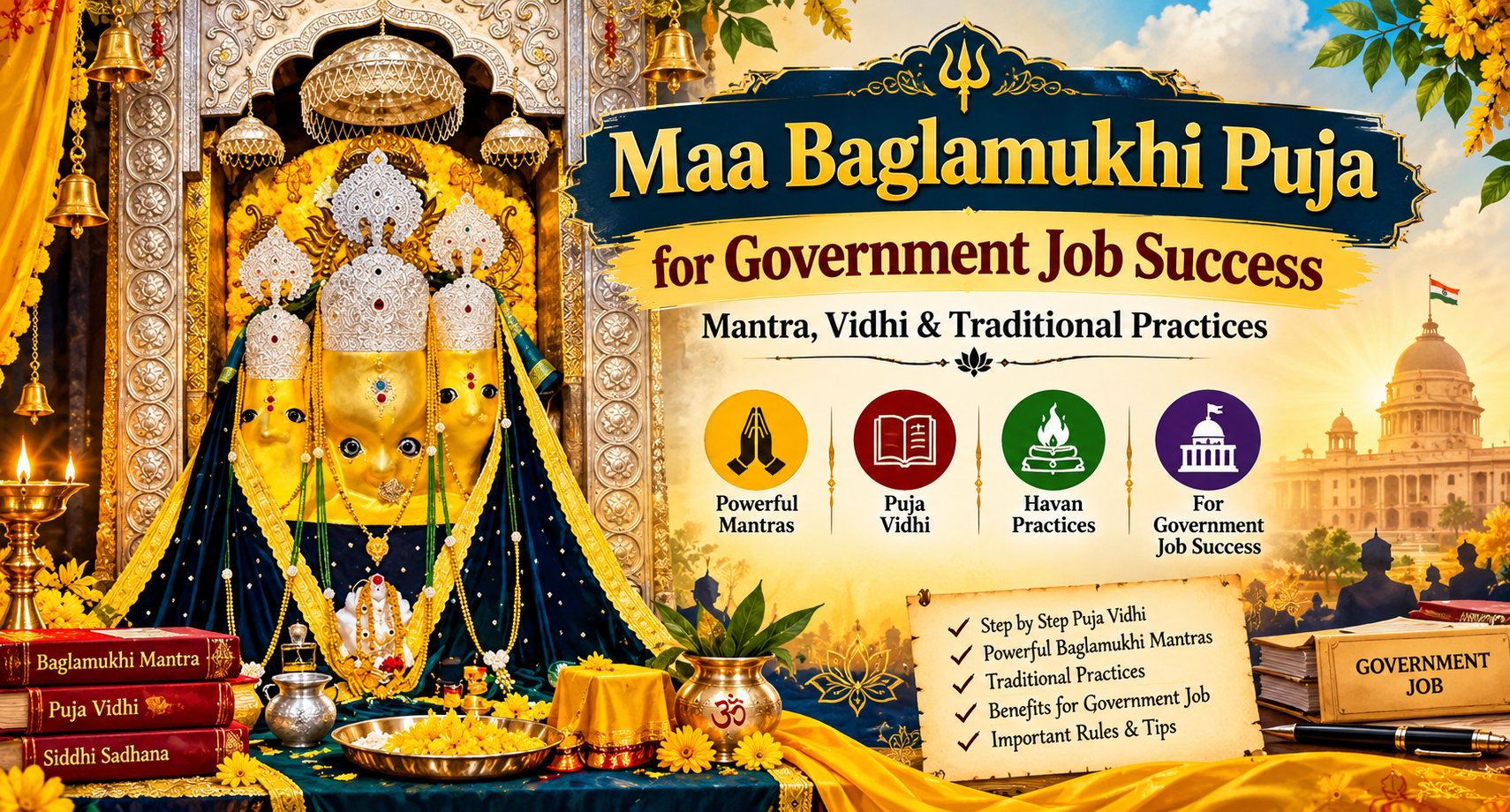
Preparing for a government job can be one of the most demanding phases of a person's life. From UPSC and SSC examinations to banking, railway, teaching, defence-related recruitment, and state government examinations, aspirants often spend months or years preparing for opportunities that attract intense competition.
The challenge is not limited to completing a syllabus. Students must manage revision, application deadlines, mock tests, interviews, uncertainty about results, and sometimes pressure from their families.
During this journey, some Hindu devotees turn to prayer as a source of spiritual support. Maa Baglamukhi Puja is among the traditional forms of worship that devotees may consider while working towards important career aspirations.
Maa Baglamukhi is revered within the Dash Mahavidya tradition and is associated with Stambhan Shakti, a concept traditionally connected with restraint and stillness. Devotees may interpret these associations as meaningful when praying for steadiness, courage, clarity, and the ability to face difficult circumstances.
However, an important distinction must be understood: no puja, mantra, havan, or spiritual practice can guarantee government job selection. Recruitment depends on eligibility, preparation, examination performance, vacancies, applicable rules, and official selection procedures.
This guide explains how devotees may approach Maa Baglamukhi Puja for government job aspirations, what traditional mantra and worship practices involve, how personal prayer differs from formal rituals, and what questions to ask before making a booking.
Readers who want to understand the available services can also explore the government job puja information and Maa Baglamukhi Student Puja pages.
Quick Answer: Can Maa Baglamukhi Puja Be Performed for Government Job Aspirations?
Yes. Devotees may worship Maa Baglamukhi while praying for guidance, courage, determination, and spiritual support during government job preparation.
Common devotional approaches include:
A brief personal prayer at home.
Respectful remembrance of Maa Baglamukhi.
Learning a traditional mantra from a knowledgeable teacher.
Performing simple puja according to family custom.
Arranging a priest-led puja or havan when personally desired.
These practices reflect religious belief rather than scientifically established methods of obtaining employment.
An aspirant should continue to prioritise their syllabus, previous-year questions, revision, mock tests, physical or skill requirements where applicable, and interview preparation.
For guidance focused on examination preparation, readers may explore the existing Competitive Exam Success resource.
Why Do Devotees Worship Maa Baglamukhi?
Maa Baglamukhi is commonly counted among the ten Mahavidyas, a group of divine forms revered in Shakta Hindu traditions.
She is also called Pitambara Devi, a name associated with yellow attire and imagery. Traditional representations frequently include yellow clothing and ornaments, and the colour yellow has become particularly significant in her worship.
Understanding Stambhan Shakti
The Sanskrit term stambhana is associated with stopping, restraining, or rendering something still.
In traditions associated with Maa Baglamukhi, the concept appears in discussions of speech, opposition, conflict, and spiritual power.
This does not mean devotees should regard other examination candidates as enemies or attempt to interfere with anyone's opportunities. Healthy competition, fairness, merit, and respect for others remain important.
For a government job aspirant, a constructive personal interpretation may be to pray for composure when facing uncertainty and the strength to act responsibly.
Such an interpretation should not be mistaken for proof that a ritual changes examination marks or recruitment decisions.
Why her worship appeals to some aspirants
An examination candidate may be dealing with several concerns simultaneously:
Difficulty maintaining discipline across a long preparation period.
Fear after unsuccessful examination attempts.
Nervousness before a high-stakes interview.
Uncertainty about results and future opportunities.
The emotional strain of balancing preparation and other responsibilities.
For people who already practise Hindu devotion, prayer can form a familiar part of their daily routine.
The worship should be a freely chosen expression of faith, not a response to claims that an examination failure proves the presence of a curse or supernatural obstruction.
Readers interested in the religious background can consult the website's Maa Baglamukhi story and Mahavidya guide.
Maa Baglamukhi Mantra for Government Job Aspirants
People often search for a Baglamukhi mantra specifically for a government job, examination, interview, or career goal.
The important starting point is that traditional Baglamukhi mantras are religious formulas. They are not government-exam-specific techniques, and their meaning should not be changed to create promises about particular outcomes.
A commonly published Baglamukhi mantra
One traditional mantra version reproduced in the website's mantra resources is:
Devanagari
ॐ ह्लीं बगलामुखि सर्वदुष्टानां वाचं मुखं पदं स्तम्भय जिह्वां कीलय बुद्धिं विनाशय ह्लीं ॐ स्वाहा॥
Transliteration
Om Hleem Baglamukhi Sarva Dushtanam Vacham Mukham Padam Stambhaya Jihvam Kilaya Buddhim Vinashaya Hleem Om Svaha.
Editorial verification note: This represents a commonly published form, not a universal scholarly standard. Spellings, endings, transliterations, and ritual usage may differ across lineages. A qualified practitioner should verify the exact wording and whether this mantra is appropriate for a particular devotee before publication as instructional guidance.
What does this mantra mean?
The mantra invokes Maa Baglamukhi and contains traditional expressions related to restraint of hostile speech, opposition, and destructive intellect.
Its meaning should not be simplified into a statement such as "chant this mantra to obtain a government job." That would misrepresent the traditional content.
Some expressions in the longer mantra belong to specialised devotional and Tantric contexts. A person unfamiliar with those contexts should seek guidance rather than treating the mantra as an ordinary motivational affirmation.
An aspirant whose primary intention is peaceful personal devotion can begin with a simple prayer to the Goddess instead of undertaking advanced mantra practice independently.
The website offers further explanatory reading in its Maa Baglamukhi Mantra guide and Baglamukhi Beej Mantra Hleem guide.
Is there a government job-specific mantra?
Different religious teachers and devotional websites may associate existing Baglamukhi mantras with career aspirations.
However, describing a traditional mantra as a guaranteed "government job mantra" would be misleading.
Before adopting any published version, ask:
What is the traditional source or lineage?
Is the pronunciation being taught correctly?
Is this appropriate for beginners?
Does the practice require initiation or supervision?
Are its claimed benefits being presented as beliefs rather than certainties?
The answers are more useful than exaggerated assurances about selection, ranks, or appointments.
Maa Baglamukhi Mantra Jaap Vidhi: A Beginner's Approach
Mantra jaap means repeating a sacred mantra as a devotional practice.
The procedure can vary according to tradition, family custom, the particular mantra, and guidance received from a guru or priest.
Someone preparing for an examination does not need to undertake an elaborate spiritual programme merely because a job opportunity is important.
Step 1: Choose a suitable space
Select a clean, quiet place where you can sit without unnecessary interruption.
A dedicated prayer room is not essential for a simple personal prayer. A small, respectful space within the home may be sufficient.
Step 2: Begin with a respectful intention
A devotee may express an intention to develop patience, discipline, clarity, and the strength to fulfil responsibilities.
This intention can include a career aspiration without demanding a guaranteed outcome.
For example:
"May I prepare sincerely, act honestly, remain courageous during challenges, and use any opportunity I receive responsibly."
This is a suggested personal prayer, not a traditional Sanskrit mantra.
Step 3: Learn before chanting
If you intend to chant a traditional mantra, first understand its pronunciation and religious context.
Do not rely on a social media video that promises instant results or says that a single pronunciation error will cause harm.
A knowledgeable teacher can explain the differences between simple devotional remembrance and more specialised mantra sadhana.
Step 4: Practise consistently without disrupting responsibilities
Some traditions use a mala to count mantra repetitions. The number of repetitions and the length of an observance depend on the practice being followed.
Neither 108 repetitions nor a 40-day observance should be described as a universally necessary condition for obtaining employment.
For examination candidates, any spiritual routine should remain compatible with sleep, classes, revision, and daily responsibilities.
Step 5: End with gratitude
A short period of quiet reflection can conclude a personal prayer session.
Then return to the practical task at hand, whether that is studying a subject, solving a question paper, completing an application, or practising an interview response.
What should beginners avoid?
Beginners should avoid undertaking specialised Tantric procedures without appropriate guidance, following extreme restrictions, purchasing costly items under pressure, or believing that breaking a self-imposed routine will necessarily cause misfortune.
The website's Mantra Jaap method and rules, best time for chanting guide, and home sadhana precautions provide additional traditional context. Practices described in those resources should be evaluated according to the devotee's circumstances and qualified guidance.
Maa Baglamukhi Puja Vidhi for Job Aspirants
A common question is whether a person must arrange an elaborate puja or can simply worship at home.
The answer depends on the nature of the intended practice.
Simple devotional worship and a formal priest-led ritual are different activities. They should not be presented as interchangeable ceremonies with identical requirements.
Simple personal worship at home
For someone who follows Hindu devotional customs, a basic routine may involve:
Cleaning the place of worship.
Sitting respectfully before an image of the Goddess, if available.
Offering a personal prayer.
Making simple offerings according to family tradition.
Spending a brief period in devotional remembrance.
Concluding with gratitude.
This is a general illustration of personal devotion, not a prescribed complete Baglamukhi ritual.
Offerings may include flowers or other items considered appropriate by a family's tradition. No expensive material is inherently necessary for a short personal prayer.
If using a lamp or incense, observe ordinary fire safety precautions.
Formal priest-led Baglamukhi Puja
A formal ceremony may include a sankalp, preliminary invocations, offerings, mantra recitation, and concluding prayers.
A priest may determine the exact procedure according to the ritual being requested, local custom, and the tradition followed.
For a general explanation of the services offered by the website, see Baglamukhi Puja.
What is sankalp?
A sankalp is a statement of intention made as part of a religious observance.
In a formal ceremony, it may include identifying details and the purpose of the worship, according to the priest's procedure.
A government job aspirant might wish to pray for perseverance, clarity, ethical conduct, and success through legitimate effort.
There is no reason to present the sankalp as a mechanism that compels a recruitment board to produce a particular result.
Should the candidate or family arrange the puja?
Either may express interest, depending on personal circumstances.
Parents sometimes arrange prayers for children who are preparing for examinations. However, involving the student respectfully and considering their own beliefs is preferable to imposing a ceremony on them.
The candidate's study schedule, financial situation, and comfort should influence any decision about organising a ritual.
Maa Baglamukhi Havan for Career and Exam-Related Sankalp
A havan, also called homa in many Hindu traditions, is a ceremonial fire offering performed with prescribed prayers and materials.
Unlike ordinary personal prayer, a formal havan involves a ritual fire, specific offerings, and a sequence of invocations or recitations.
What generally happens during a havan?
Depending on the tradition and ceremony, the procedure may include preparation of the ritual area, sankalp, worship, mantra recitation, offerings to the fire, and a concluding offering known as purnahuti.
The exact materials, duration, number of priests, and ritual sequence vary.
A devotee should not assume that every havan includes the same number of mantras or that a longer ceremony will necessarily produce a better personal outcome.
Puja, mantra jaap, havan, and anushthan compared
A formal ceremony should be chosen according to personal faith and informed preference, not because someone claims it is mandatory to prevent failure.
The website explains its Maa Baglamukhi Hawan services and provides a separate Baglamukhi Havan guide.
Considering a puja or havan? Review the available service options and clarify the arrangements, cost, ritual format, and participation requirements before proceeding.
When Should Devotees Perform Maa Baglamukhi Puja?
Some devotees follow religious calendars, auspicious timings, lunar dates, or family customs when arranging ceremonies.
However, there is no universally established day on which every government job aspirant must worship Maa Baglamukhi to obtain selection.
A formal priest-led ceremony may be scheduled after consultation about the ritual and preferred date.
For a personal prayer, consistency and convenience may be more relevant than an elaborate schedule.
Before an examination
An aspirant may wish to offer a short prayer before leaving for an examination.
Practical priorities remain checking the admit card, identification documents, permitted materials, reporting time, and travel route.
Prayer should not make someone late or interfere with examination-centre instructions.
During the preparation period
Those who find daily devotion meaningful may place a brief prayer before a study session or during a suitable break.
A routine that creates anxiety, consumes essential study hours, or requires unaffordable spending is not serving the student's broader interests.
Before an interview
A candidate may pray for courage and clarity before an interview, while also preparing through subject revision, mock interviews, and knowledge of the recruiting organisation.
Specific advice for this stage is available in the website's Interview Success resource.
Can Students and Competitive Exam Aspirants Worship Maa Baglamukhi?
Students preparing for government recruitment examinations can participate in personal worship if it aligns with their beliefs and circumstances.
There is no need to frame every examination setback as the result of a spiritual problem.
A student who repeatedly misses a cutoff may benefit from examining subject-wise accuracy, time management, negative marking, and weaknesses revealed by mock tests.
Spiritual practice may provide personal encouragement, but only practical analysis can reveal whether preparation is addressing the actual examination requirements.
For UPSC aspirants
UPSC preparation involves a structured syllabus, current affairs, analytical understanding, writing practice, and examination-specific requirements.
A devotee may choose a personal prayer routine, but should not allow it to replace revision or answer-writing practice.
Candidates considering a specialised service can examine the existing IAS and IPS Success page while keeping its devotional claims separate from official recruitment criteria.
For SSC, railway, banking, and state examinations
These examinations require different combinations of general awareness, quantitative ability, reasoning, language proficiency, domain knowledge, or other officially specified competencies.
A practical preparation plan should follow the latest official syllabus and examination pattern.
Regular timed practice is particularly important where accuracy and speed influence performance.
For candidates facing repeated setbacks
Repeated unsuccessful attempts can affect confidence and motivation.
It is worth reviewing score reports, cutoffs, eligibility, preparation methods, and whether an alternative examination or career route may be appropriate.
Seeking help from an experienced teacher or mentor can be valuable.
Religious practices should not become a source of guilt or lead someone to believe that unsuccessful results indicate insufficient devotion.
Spiritual Practices and Practical Government Job Preparation
The most responsible approach is to keep spiritual activities optional and clearly separate from the measurable requirements of an examination.
A balanced daily example
Consider a candidate who has six hours available for serious preparation.
Their plan might include three focused study blocks, short breaks, revision, timed questions, and a final review of errors.
If they wish, they could begin with a short prayer and then move directly into the planned work.
There is no need for a separate, lengthy ritual each time a subject feels difficult.
An aspirant should judge preparation progress through completed syllabus portions, accuracy, mock-test performance, and demonstrated understanding rather than assuming devotional activity changes recruitment outcomes.
The importance of realistic expectations
A government recruitment process may be affected by vacancies, reservation and eligibility rules, examination scores, normalisation where applicable, document verification, medical or physical requirements, and official administrative decisions.
Spiritual belief does not remove these requirements.
Candidates should rely on official recruitment sources for notices and results, while keeping religious practice within the personal sphere.
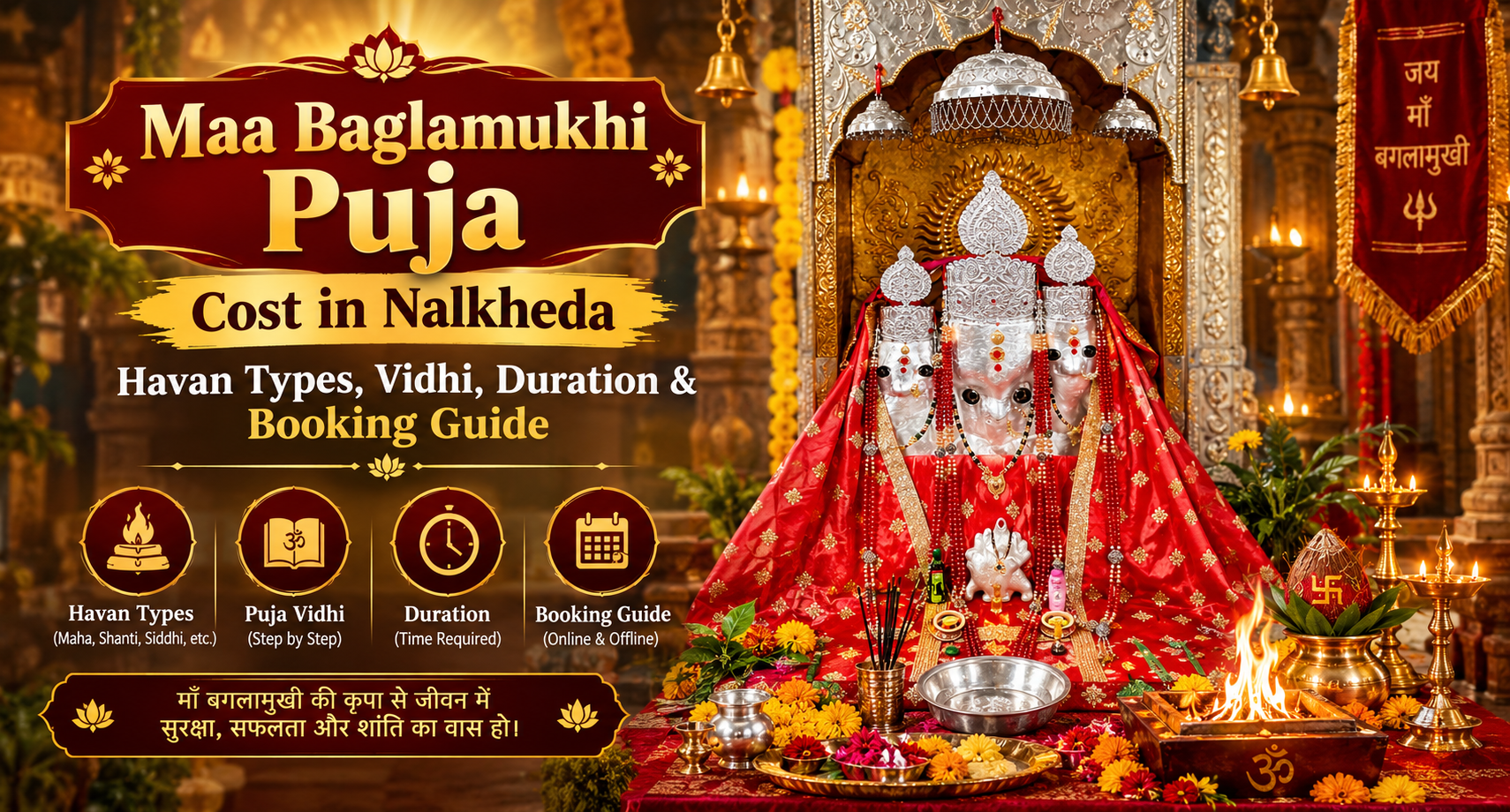
Maa Baglamukhi Puja in Nalkheda: What Should Devotees Know?
Nalkheda in Madhya Pradesh is associated with Maa Baglamukhi worship and attracts devotees interested in the Goddess's religious traditions.
MaaBaglamukhi.guru presents information about puja and related services associated with Nalkheda.
However, a religious service website should not automatically be understood to represent the government, temple trust, or official temple administration.
Any claim of official affiliation must be independently verified.
What should visitors confirm?
Before travelling, contact the relevant provider or temple administration to clarify:
The correct venue and its location.
The date and available visiting arrangements.
Whether advance registration is necessary.
Whether a particular ritual is performed at the chosen venue.
Whether the selected priest or service provider is authorised to make the stated arrangements.
Whether photographs or video participation are permitted.
Applicable charges, if any.
Visitors should also plan transport, accommodation, weather-appropriate clothing, and enough time for unexpected changes.
Avoid relying on old social-media posts for current opening hours or access arrangements.
Can a devotee enquire from another city?
The website describes options for puja arrangements, including some services with online participation.
These are provider descriptions, so actual availability and the format of participation should be confirmed before booking.
A remote participant should ask how the sankalp is performed, whether there is a live video session or recording, and what documentation or confirmation is provided.
How to Enquire About Maa Baglamukhi Puja
The website has a dedicated puja booking page through which visitors can explore the booking process.
A prospective devotee should start by identifying the actual service they wish to discuss rather than booking an unfamiliar ceremony solely because of its name.
Step 1: Explain your enquiry
State whether you are interested in personal prayer guidance, a student-oriented puja, a general Baglamukhi Puja, or a havan.
If the intention relates to an examination or job aspiration, explain that context without expecting a guaranteed result.
Step 2: Confirm the available options
Ask what each option includes.
A service labelled "puja" may differ considerably from a havan or multi-day anushthan.
Request an explanation in ordinary language rather than relying only on specialised terminology.
Step 3: Request the cost and inclusions
Confirm the current quotation, ritual materials, priest arrangements, expected duration, and any additional charges.
Do not assume that a displayed starting price covers every possible arrangement.
For additional context, see the Nalkheda Puja cost and booking guide.
Step 4: Clarify scheduling and participation
Ask whether the preferred date is available and whether you are expected to attend in person.
If participating remotely, clarify the communication method, timing, and what will happen if the scheduled session needs to change.
Step 5: Review confirmation details
Before making any payment, make sure the description, price, service provider, and arrangements are clear.
Keep a copy of the confirmation and any relevant written terms.
Would you like to understand the available worship options? Visit the Maa Baglamukhi Puja booking page and confirm the ritual details directly before making a decision.
Common Questions Before Booking a Puja
Use this checklist when speaking with a priest or service provider.
What is the exact name of the ceremony?
Is it simple puja, mantra jaap, havan, or anushthan?
Who will perform the ceremony?
Where will it take place?
How long will it take?
Which materials are included?
Is the quoted amount the complete cost?
Is attendance required?
Can the family participate remotely?
How is the sankalp explained and recorded?
Will the procedure follow a particular religious tradition?
Are any preparations expected from the devotee?
What happens if the date must change?
What confirmation will be issued?
Is there a clear cancellation or rescheduling policy?
No one should feel pressured to agree immediately to a ritual or payment.
Devotion is a personal matter, and a responsible provider should be willing to explain the available choices without fear-based sales language.
Frequently Asked Questions
1. Can Maa Baglamukhi Puja be performed for government job aspirations?
Yes. Some devotees perform Maa Baglamukhi Puja while praying for courage, guidance, and spiritual support during career preparation. It does not guarantee employment or selection.
2. Which Maa Baglamukhi mantra do devotees traditionally chant?
Different Baglamukhi mantras are used within different devotional contexts. Beginners should consult a knowledgeable teacher about the correct wording, pronunciation, and suitability of a specific mantra.
3. What does the traditional Baglamukhi mantra mean?
Common forms invoke Maa Baglamukhi and include language associated with restraining harmful speech and opposition. A proper explanation requires attention to the specific Sanskrit text and its traditional context.
4. How should a beginner approach mantra jaap?
Begin by learning about the practice, understanding its devotional purpose, and seeking guidance where appropriate. A simple prayer may be preferable to attempting specialised mantras without instruction.
5. Is there a specific day for Maa Baglamukhi Puja?
Traditions and priests may recommend particular timings for formal ceremonies. There is no universal rule establishing a mandatory day for government job aspirants.
6. Can students worship Maa Baglamukhi before competitive examinations?
Yes, students who follow this devotional tradition may pray before examinations. They should still prioritise preparation, sleep, travel planning, and examination instructions.
7. Is a havan necessary for every devotee?
No. Personal prayer and formal havan are different religious practices. A havan is not a universal requirement for every person who wishes to worship Maa Baglamukhi.
8. What is the difference between Baglamukhi Puja and Havan?
Puja generally refers to a form of worship involving prayer and offerings. Havan specifically involves ceremonial offerings into a ritual fire, usually following a more structured procedure.
9. Can I perform simple worship at home?
Yes, simple devotional prayer may be performed at home according to personal and family tradition. More specialised rituals may require guidance from a knowledgeable practitioner.
10. Should I consult a priest about formal Baglamukhi rituals?
Consulting a knowledgeable priest is advisable when considering a formal ceremony, especially if unfamiliar with the mantra, materials, ritual sequence, or traditional restrictions.
11. Can any puja guarantee a government job?
No. Government job selection depends on official recruitment requirements and performance. No religious ceremony can guarantee marks, rankings, interviews, appointments, or postings.
12. How can I balance spiritual practice with exam preparation?
Keep devotion brief and optional if your schedule is demanding. Protect time for study, revision, mock tests, application requirements, rest, and physical wellbeing.
13. What should I confirm before arranging a puja?
Confirm the service, provider, cost, inclusions, date, location, participation options, and written booking terms. Ask for clarification before making payment.
14. Can I enquire about Maa Baglamukhi Puja in Nalkheda?
Yes. The website provides information about Nalkheda-associated puja services and offers a booking enquiry route. Confirm the actual venue and provider details directly.
15. Where can I find current booking details?
Visit the website's booking or service pages and contact the provider for current arrangements. Published descriptions do not necessarily establish availability on a particular date.
16. Does the puja procedure vary by tradition?
Yes. Ritual procedures may differ by lineage, regional custom, priest, and the particular type of ceremony being performed.
17. How can I verify a mantra's correct wording?
Compare credible traditional references and consult a knowledgeable Sanskrit or religious practitioner. Avoid assuming that every transcription found online is identical.
18. What practical steps should I take alongside prayer?
Study the official syllabus, solve previous-year papers, attempt mock tests, analyse mistakes, track recruitment notices, meet eligibility requirements, and prepare for interviews or other selection stages.
19. Can parents arrange puja for a student?
Families may arrange devotional ceremonies according to their beliefs. They should consider the student's wishes, schedule, and comfort, particularly during intensive examination preparation.
20. What if I cannot afford a formal puja?
You do not need to spend money you cannot afford. Personal prayer is an alternative for devotees who wish to express their faith, and financial resources needed for education and daily living should remain priorities.
Conclusion: Keep Faith and Preparation Together
Maa Baglamukhi Puja for government job success is best understood as a faith-based devotional practice that some aspirants choose while navigating an important career goal.
Traditional worship may include personal prayer, mantra jaap, puja, or havan, with the exact practice depending on the devotee's beliefs and religious guidance.
The spiritual meaning of these practices should be respected without turning them into promises of examination selection or guaranteed employment.
For a government job aspirant, preparation remains essential. Studying consistently, correcting mistakes, following official recruitment requirements, and maintaining wellbeing are responsibilities that no ritual can replace.
If you wish to explore a formal ceremony, review the available options and make an informed, affordable decision.
For questions about Maa Baglamukhi worship, visit the service information page or enquire about puja arrangements.
Faith may be part of your personal journey. Your preparation, integrity, and informed decisions remain central to your career path.