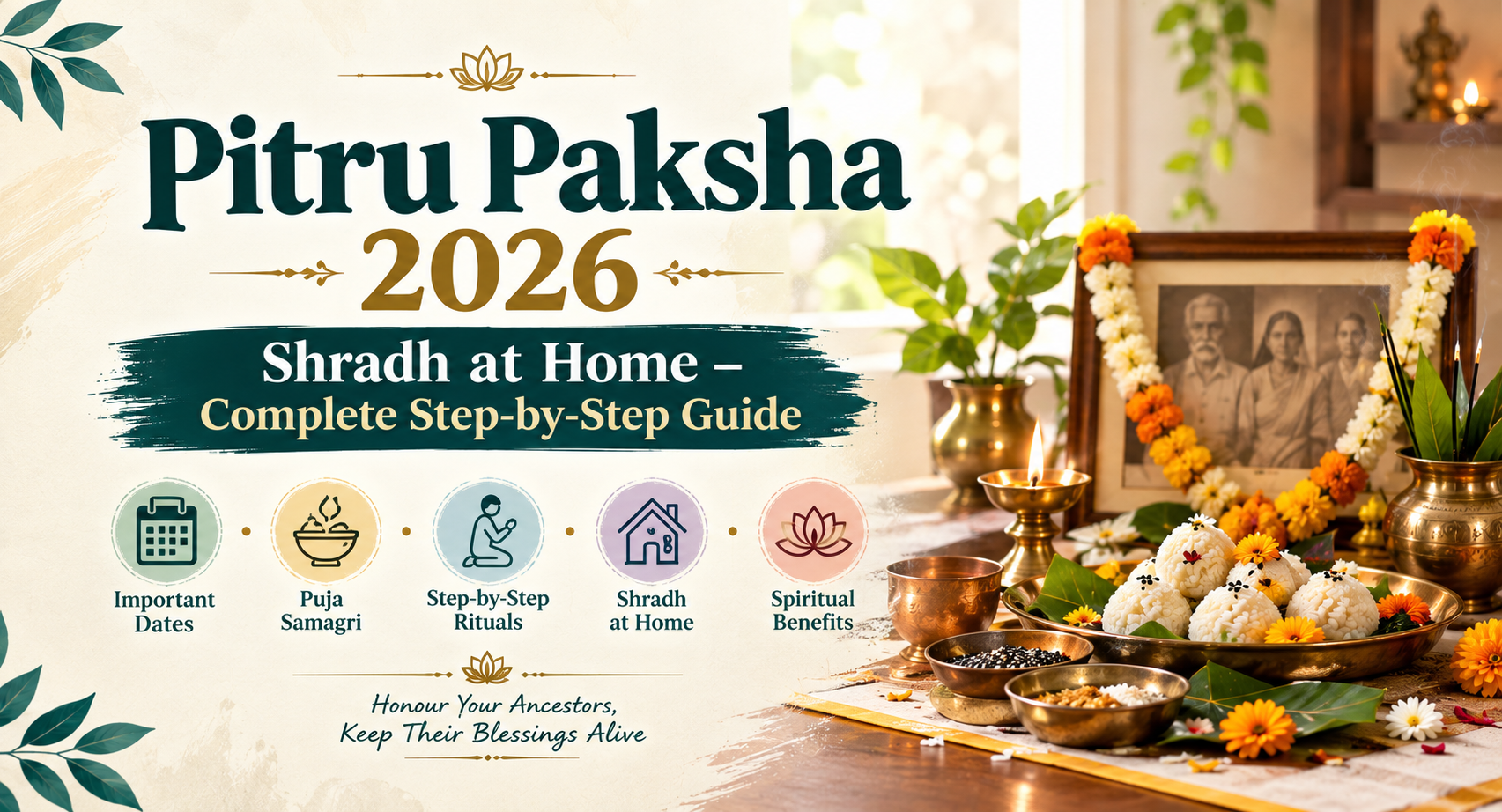
Yes, Shradh can traditionally be observed at home, and for most families this is the most common way it is done. At its core, home Shradh involves cleaning and preparing a quiet space, arranging simple Samagri, performing Sankalp (a formal intention), offering Tarpan to your ancestors, preparing Satvik food, and sharing it as prasad or charity. The correct Shradh Tithi — the lunar date linked to your ancestor's passing — matters because that is the day the ritual is traditionally addressed to them. That said, customs differ quite a bit by region, Sampradaya and family, so this guide focuses on the general process most households follow, while encouraging you to check specifics with your family elders or a knowledgeable priest.
Quick Answer
Performing Shradh at home generally follows this broad sequence: 1) determine the correct Shradh Tithi for your ancestor, 2) clean and prepare the worship area, 3) arrange the required Puja Samagri, 4) perform Sankalp to state your intention, 5) offer Pitru Tarpan with water and black sesame, 6) complete any Pind or other offerings your family tradition follows, 7) prepare and offer traditional Satvik food, 8) share food or give charity to Brahmins, cows, crows or those in need, and 9) conclude the ritual respectfully. The exact sequence, mantras and items used can vary meaningfully by Sampradaya, region and family custom — this guide gives the commonly followed structure, not a single universal rulebook.
Pitru Paksha 2026
Pitru Paksha 2026 begins on 26 September 2026 with Purnima Shraddha and concludes on 10 October 2026 with Sarva Pitru Amavasya. Shradh for a specific ancestor is generally performed on the Tithi that matches their date of passing, not on a fixed calendar date, so the exact day will differ from family to family. For the complete day-by-day Tithi calendar, see our Pitru Paksha 2026 Shradh Tithi Calendar and Pitru Paksha 2026 dates and Puja Vidhi guide. Muhurat timings such as Kutup, Rohina and Aparahna Kaal can shift by a few minutes depending on your city, so it's worth confirming exact timings with a local Panchang rather than relying on a generic list.
Who Can Perform Shradh?
Traditionally, the eldest son or another male descendant is considered the primary performer of Shradh in many communities, since certain rites are historically linked to that role. In practice, though, an eligible relative — a brother, nephew, grandson, or another close family member — often performs the rituals if the usual performer is unavailable, out of the country, or unwell. Some families, especially where the eldest son is not present, do permit a daughter, widow, or other woman in the family to perform Shradh or Tarpan, following their own household or regional custom. Traditional practices differ among communities and family traditions, and there is no single rule that applies everywhere. If your family is unsure who should perform the ritual this year, it is worth asking an elder or consulting a knowledgeable priest rather than assuming one fixed answer.
When to Perform Shradh
The single most important factor in home Shradh is identifying the correct Tithi — the lunar day that corresponds to your ancestor's date of death. Hindu Shradh follows the lunar calendar rather than the English calendar, so the same ancestor's Shradh date shifts each year. If you know the Tithi (for example, Saptami or Ashtami), you match it to the corresponding date within Pitru Paksha 2026. Because Tithi timings can vary by a few hours depending on your location, it's advisable to check a local Panchang, especially if the Tithi falls close to sunrise or sunset. If the exact Tithi is not known — or if the appropriate day has already passed — many families perform the ritual on Sarva Pitru Amavasya, observed on 10 October 2026, since this day is broadly considered suitable for ancestors whose Tithi is unclear. You can read more in our dedicated guide to Sarva Pitru Amavasya 2026.
Shradh Puja Samagri
Below is a practical checklist of items commonly used for home Shradh. Not every item is mandatory for every family — requirements vary by tradition, so treat this as a starting reference rather than a fixed rulebook.
Keep the list simple. Families who follow a Purohit-guided ceremony may be given a slightly different or more elaborate list; families doing a simpler home observance often manage comfortably with the essential items above.
How to Prepare Your Home
Clean the space thoroughly. A tidy, quiet corner of the home — often near the Puja area or a balcony/terrace with access to open sky — works well.
Choose a calm, undisturbed area. Shradh is a reflective ritual, so a space away from household noise and foot traffic is preferable.
Arrange the Samagri in advance. Having everything ready before you begin helps the ritual flow smoothly and avoids interruptions.
Prepare food mindfully. Cooking should ideally be done with cleanliness and without tasting the food before it is offered, according to many family traditions.
Maintain personal and kitchen hygiene throughout the day, as cleanliness is considered important to the observance.
Keep the ritual area undisturbed until the offerings are complete — avoid using it for unrelated household tasks that day.
Specific directional preferences (such as facing south during Tarpan) are followed in many traditions, but should be treated as tradition-specific rather than a universal requirement — confirm with your family's custom or a priest if you are unsure.
Shradh Vidhi at Home
This is the core step-by-step process most households follow for home Shradh. Treat each step as a general guide; your family Purohit or elders may adjust the order or details slightly.
Step 1: Clean and Prepare the Space
Sweep and clean the chosen area, and lay out an Aasan (seating mat) for the person performing the ritual. This sets a respectful tone before anything else begins.
Step 2: Personal Preparation
The performer typically bathes before starting the ritual, ideally before or shortly after sunrise, and wears clean clothes. This is considered part of preparing oneself mentally and physically for the observance.
Step 3: Arrange the Samagri
Place the water vessel, sesame seeds, Kusha grass, rice, flowers, diya and other items within easy reach so the ritual isn't interrupted midway.
Step 4: Sankalp
Sankalp is a short declaration of intent — stating the date, the ancestor being remembered, and the purpose of the ritual. Many families recite this in the presence of a priest or by following a written format; if you're unfamiliar with the exact wording, a knowledgeable priest can guide you through it rather than risk an incorrect declaration.
Step 5: Pitru Tarpan
Tarpan is the offering of water mixed with black sesame seeds to one's ancestors, typically poured using folded hands or a small vessel. It is usually done facing south, which is traditionally associated with the direction of the ancestors, while mentally remembering the departed family member. This step can be performed simply, even without an elaborate setup, which is why many families are able to complete Tarpan at home on their own.
Step 6: Pind or Other Offerings Where Traditionally Practised
Some families include Pind Daan — offering small rice-ball formations — as part of home Shradh, while others reserve this for pilgrimage sites like Gaya or leave it to a priest-led ceremony. If your family tradition includes this step at home, it is usually guided closely by a Purohit, since the exact preparation and mantras involved benefit from experienced guidance.
Step 7: Prepare and Offer Food
A Satvik meal is prepared and a portion is formally offered — often placed on a leaf or plate — before the family eats. This offering is done with the intention of nourishing and honouring the ancestor being remembered that day.
Step 8: Charity and Respectful Offerings
Food, clothing or money may be given to Brahmins, the needy, or offered to cows, crows and other animals, depending on family custom. This is traditionally seen as extending the ritual's spirit of generosity beyond the immediate household.
Step 9: Conclude the Ritual
The ritual is typically closed with a short prayer of gratitude and remembrance, after which the family eats together. Some households also light a diya for the rest of the day as a mark of respect.
What Food Is Prepared for Shradh?
Shradh food is generally Satvik — simple, vegetarian, and prepared without onion and garlic in many traditions. Common preparations include plain rice, dal, seasonal vegetables, roti, and a sweet dish such as kheer, along with fresh fruits. Some communities include specific regional dishes tied to their own customs, such as particular lentil preparations or sweets associated with the family deity or region. Because food traditions vary meaningfully by community, it's worth checking with family elders on any specific dos and don'ts your household follows. For a broader look at ritual etiquette during this period, see our guide on Pitru Paksha Do's and Don'ts.
Can Shradh Be Done Without a Priest?
Simple remembrance practices — particularly daily Tarpan with water and sesame seeds — can often be performed at home by family members themselves, according to many family traditions. This makes basic ancestral remembrance genuinely accessible without needing a priest present every day. However, more elaborate Shradh ceremonies, especially those involving detailed Sankalp wording, Pind Daan, or a full sequence of Vedic mantras, are usually performed with the guidance of a knowledgeable priest, since incorrect wording or sequencing is a common concern for those unfamiliar with the process. If you're uncertain about any part of the ritual, it is reasonable — and quite common — to have a priest guide you through it rather than treat the entire ceremony as a do-it-yourself task.
What If the Shradh Tithi Is Unknown?
It's fairly common for families to lose track of an ancestor's exact death Tithi over the years, especially across generations. In such cases, many traditions hold that performing Shradh on Sarva Pitru Amavasya (10 October 2026) is an appropriate and widely accepted option, since this day is broadly regarded as suitable for ancestors regardless of their specific Tithi. This is not necessarily the only solution in every tradition, though — some families instead ask a priest to help identify the closest applicable Tithi based on other known details. If your family has lost track of a Tithi, checking with an elder or a knowledgeable priest for your specific circumstances is a sensible next step. Read more in our detailed guide to Sarva Pitru Amavasya 2026.
Common Mistakes During Shradh
Performing the ritual on the wrong Tithi by confusing the English calendar date with the lunar Tithi.
Rushing through the process to "finish quickly," which can undermine the reflective purpose of the ritual.
Treating every internet checklist as mandatory, when many items and steps are tradition-specific.
Ignoring established family tradition in favour of a generic online guide.
Using unverified or incorrectly pronounced mantras picked up from unreliable sources.
Confusing simple Tarpan with a complete Shradh ceremony — they are related but not identical.
Focusing only on ritual items while losing sight of the remembrance and respect the ritual is meant to express.
Making exaggerated claims about guaranteed results, which has no basis in traditional practice.
Ignoring local Panchang differences, especially for families living far from where the Panchang reference was calculated.
Not preparing in advance, leading to missing items or an incomplete ritual midway.
What to Do
Confirm your ancestor's correct Tithi in advance using a reliable Panchang.
Keep the ritual space clean and undisturbed throughout.
Follow your own family's established customs where they exist.
Approach the day with sincerity and remembrance rather than treating it as a checklist exercise.
Ask a knowledgeable priest for guidance on any step you're unsure about.
What to Avoid
Performing the ritual carelessly or in a rush.
Mixing rituals from different, unrelated traditions without understanding them.
Making the day about elaborate display rather than genuine remembrance.
Assuming one universal rule applies to every family and region.
For a fuller list of ritual etiquette, see our complete Pitru Paksha Do's and Don'ts guide.
Shradh at Home Checklist
[ ] Confirm the correct Shradh Tithi
[ ] Clean and prepare the ritual area
[ ] Arrange all Samagri in advance
[ ] Prepare Satvik food
[ ] Keep water and Tarpan items ready
[ ] Perform Sankalp
[ ] Perform Pitru Tarpan
[ ] Complete any family-tradition-specific offerings
[ ] Offer food or charity as appropriate
[ ] Conclude the ritual respectfully
Is Shradh Related to Pitru Dosh?
Shradh and Pitru Dosh are related in theme but are not the same thing. Shradh is a ritual observance — an act of remembrance, gratitude and offering performed for one's ancestors during Pitru Paksha and on their death anniversary. Pitru Dosh, on the other hand, is a separate astrological concept referring to specific planetary placements in a birth chart that some traditions associate with ancestral displeasure or unresolved family karma. While sincere Shradh is generally seen as a respectful way to honour ancestors, it should not be presented as a guaranteed remedy that removes Pitru Dosh — that is a distinct matter best discussed with an experienced astrologer or priest. You can learn more about this topic on our Pitru Dosh page and in our detailed guide to Pitru Dosh Nivaran during Pitru Paksha 2026.
When to Seek Priest Guidance
There are several situations where consulting a knowledgeable priest genuinely helps: when your family follows an elaborate or specific Shradh tradition that needs correct Sanskrit recitation, when the exact Tithi is unclear, when there are special circumstances such as an ancestor who passed under unusual conditions, when the ritual involves detailed steps like Pind Daan, or when family members live outside India and cannot easily access the right resources locally. In such cases, families often prefer priest-assisted guidance rather than attempting a complex ceremony entirely on their own. If you would like support in understanding your family's Shradh requirements or arranging traditional priest-assisted puja guidance, our team can help you think through the process — without pressure and without promising specific outcomes.
Shradh for NRI Families
Families living outside India can still observe Shradh meaningfully, though a few practical points are worth keeping in mind. Tithi timings are calculated according to Indian sunrise and sunset, so the equivalent date and time in your own time zone may differ from what a standard Indian Panchang shows — it's worth cross-checking rather than assuming the same calendar date applies. Many NRI families choose to perform a simplified version of the ritual at home, focused on Tarpan, food offering and remembrance, while consulting a priest (in person or online) for the more elaborate parts of the ceremony. Maintaining your family's specific tradition, even in a simplified form, tends to matter more than replicating every ritual detail exactly. Where families prefer expert guidance, traditional priest-assisted puja options — performed on your behalf with clear communication about the process — can be a practical alternative.
Need Guidance for Shradh or Pitru Rituals?
If you're unsure about your ancestor's correct Tithi, unfamiliar with the exact Vidhi, or simply want the reassurance of experienced guidance, you don't have to work it out alone. Families who are new to performing Shradh at home, living far from a temple, or managing a more complex family tradition often find it helpful to consult a priest who can walk them through the process step by step, or arrange a traditional priest-assisted puja on their behalf. This is offered as a supportive option, not a requirement — many families perform simple Tarpan and remembrance entirely at home. If you'd like help thinking through your family's specific Shradh needs for Pitru Paksha 2026, our team is available to guide you.
Conclusion
Shradh can be meaningfully observed at home according to your family's tradition, and for most households, this is exactly how it's done every year. Getting the correct Tithi right matters, as does taking the time to prepare the space and approach the day with sincerity rather than rushing through a checklist. For simple remembrance and Tarpan, many families manage comfortably on their own; for more elaborate rituals or uncertain circumstances, guidance from a knowledgeable priest can make the process easier and more confident. However you choose to observe Pitru Paksha 2026, the intention behind the ritual — respect and remembrance for those who came before — is what the tradition ultimately centers on.
FAQs
1. Can Shradh be performed at home? Yes. Many families perform Shradh at home, particularly simpler rituals like Tarpan and food offerings. More elaborate ceremonies may be done with priest guidance, but home observance is common and traditionally accepted.
2. How do I perform Shradh at home? The general process includes confirming the correct Tithi, cleaning the ritual space, arranging Samagri, performing Sankalp, offering Tarpan, preparing food, and offering charity, concluding with a respectful close. Details vary by family tradition.
3. What is needed for Shradh at home? Commonly used items include water, black sesame seeds, Kusha grass, rice, flowers, a diya, and ingredients for a Satvik meal. Some items are optional depending on your family's specific customs.
4. Which Tithi is used for Shradh? Shradh is generally performed on the lunar Tithi that matches your ancestor's date of passing, not a fixed English calendar date. If unknown, Sarva Pitru Amavasya is commonly used instead.
5. Can Shradh be done without a priest? Simple remembrance and Tarpan can often be done at home without a priest. More elaborate ceremonies, especially those involving specific mantras or Pind Daan, are usually done with priest guidance.
6. What should be offered during Shradh? Water and black sesame during Tarpan, a Satvik meal, and often charity to Brahmins, the needy, cows or crows, depending on family tradition.
7. Can women perform Shradh? In many families, sons traditionally perform Shradh, but practices vary — some households permit daughters, widows, or other female relatives to perform it, especially when no male relative is available. Family and regional custom should be your reference point.
8. What if I do not know my ancestor's Shradh Tithi? Many traditions consider Sarva Pitru Amavasya an appropriate day for ancestors whose exact Tithi is unknown. Consulting a priest for family-specific guidance is also a good option.
9. Can Tarpan be performed at home? Yes, Tarpan — offering water mixed with sesame seeds — is one of the simplest Shradh-related rituals and is commonly performed at home by family members themselves.
10. What food is prepared during Shradh? Typically Satvik food such as rice, dal, seasonal vegetables, roti, kheer and fruits, prepared without onion and garlic in many traditions. Specific dishes vary by community.
11. What should be avoided during Shradh? Rushing the ritual, using unverified mantras, ignoring family tradition, and treating the day as a display rather than genuine remembrance are commonly cited things to avoid.
12. Is Shradh the same as Tarpan? No. Tarpan is one component of Shradh — the water and sesame offering — while Shradh is the broader ceremony that can include Sankalp, food offerings, and charity as well.
13. What is the difference between Shradh and Pind Daan? Shradh is the overall ritual of ancestral remembrance, while Pind Daan is a specific offering of rice-ball formations, often performed at pilgrimage sites like Gaya or as part of a more elaborate priest-guided ceremony.
14. Can NRI families perform Shradh from abroad? Yes. NRI families often perform a simplified version at home, adjusting for time-zone differences in Tithi timing, and may consult a priest online for more elaborate parts of the ceremony.
15. Is Shradh connected with Pitru Dosh? They are related in theme but distinct. Shradh is a ritual of remembrance; Pitru Dosh is a separate astrological concept. Shradh should not be presented as a guaranteed remedy for Pitru Dosh.
16. When is Sarva Pitru Amavasya observed? In 2026, Sarva Pitru Amavasya falls on Saturday, 10 October 2026, marking the final and most significant day of Pitru Paksha.
17. What should I do if I cannot perform Shradh on the exact Tithi? Many families perform it on the nearest suitable day or on Sarva Pitru Amavasya instead. Consulting a priest for your specific situation is advisable.
18. When should I consult a priest? When you're unsure of the correct Tithi, unfamiliar with the exact Vidhi or mantras, dealing with special family circumstances, or living outside India without easy access to guidance.