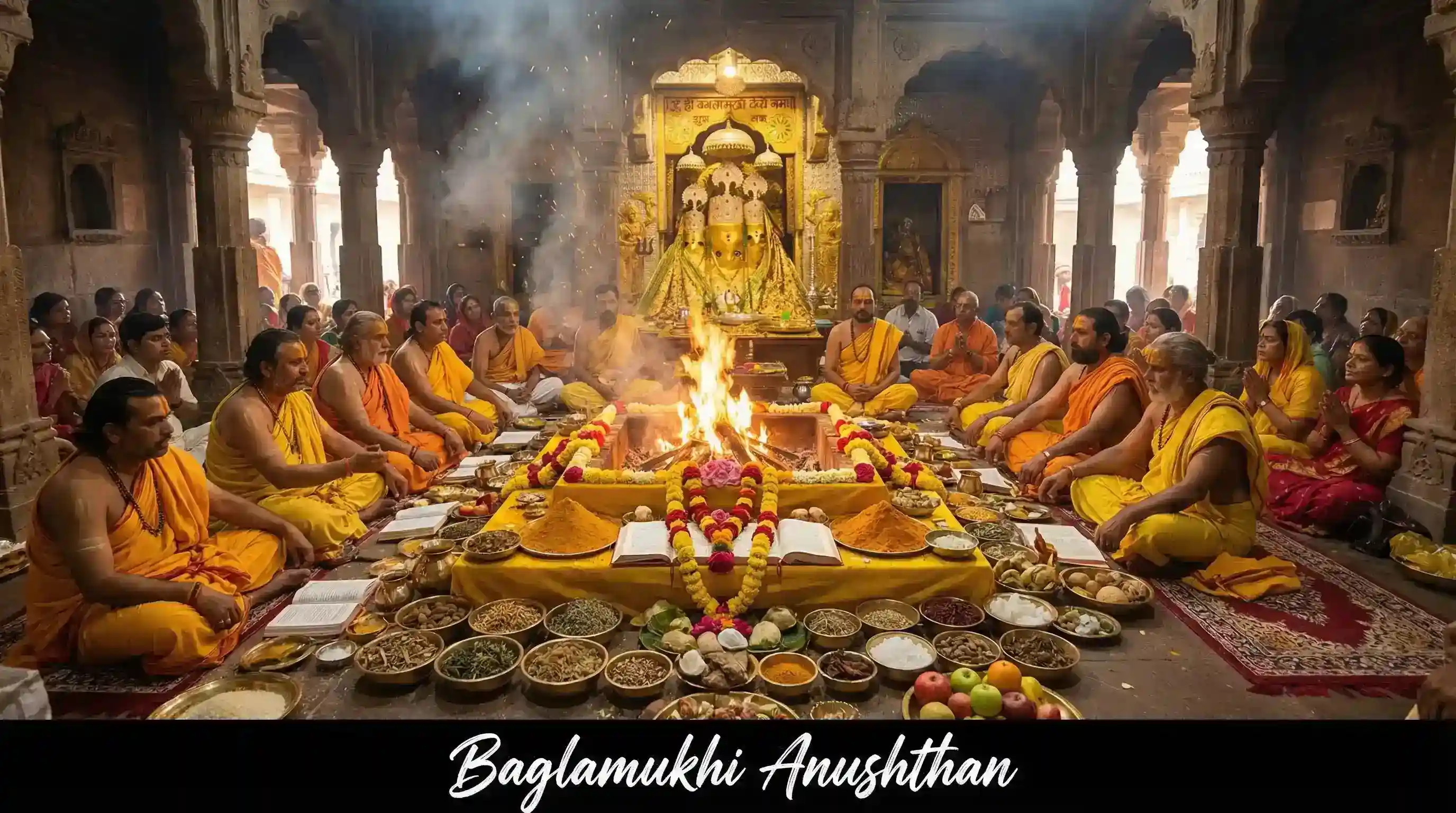
If you are searching for the right day to arrange Maa Baglamukhi Puja during Shardiya Navratri 2027, you have probably noticed that different websites give different answers. Some point to Ashtami, some to Navami, and some say any day works. This guide explains what is actually known, what is only tradition or family custom, and how to choose a date sensibly.
Shardiya Navratri 2027 begins on 11 October, so many devotees are now deciding between Puja dates. Devotees who plan to visit or book through Maa Baglamukhi Guru for a Puja at Nalkheda usually want a clear starting point, and this article gives one.
Quick Answer: Which Day Is Best for Maa Baglamukhi Puja During Shardiya Navratri 2027?
Maa Baglamukhi Puja can be arranged during Shardiya Navratri 2027, but there is no single day that is best for every devotee. The suitable date depends on the purpose of the Puja, the Tithi, the Sankalp and the guidance of the priest. Durga Ashtami (19 October) and Navami (19 to 20 October) are important days in Navratri worship, but neither is established as mandatory for Baglamukhi Puja. Confirm the date, Muhurat and ritual details before booking.
Is There One Best Day? The Short Version
No. I could not find any authoritative Panchang or scriptural source that names one Shardiya Navratri day as universally best for Baglamukhi Puja. Websites that name one are usually repeating general Navratri advice. In practice, the "best" day is the one that fits your Sankalp, the Tithi your priest recommends and the date the ritual can actually be performed.
That leaves a few practical options:
Ashtami and Navami are widely observed days of Devi worship, so many families prefer them.
Any other Navratri day is still a Devi-worship day, so a different date can be chosen based on availability.
Your family tradition or priest's guidance can override any general rule.
Pick the day that fits your purpose and circumstances, then confirm it. Do not treat any single day as a guarantee of a better result. For help choosing, you can enquire about Puja options and dates here.
Shardiya Navratri 2027 Dates at a Glance
This table follows Drik Panchang-based listings for New Delhi. Navratri runs ten calendar days this year because Saptami is current at sunrise on both 17 and 18 October. Different Panchang traditions count this differently, so treat the table as a reference and confirm locally. For a fuller schedule, see the Sharad Navratri 2027 dates and Puja Vidhi article.
Ashtami tithi runs from about 8:27 AM on 18 October to about 10:51 AM on 19 October, which is why Durga Ashtami is observed on 19 October. Ghatasthapana time is 6:19 AM to 10:12 AM in New Delhi, with Abhijit Muhurat from 11:44 AM to 12:31 PM. Times shift with your city, so check the local Panchang for Nalkheda or your location.
A smaller number of sources list Ashtami on 18 October. That is the minority view, but it shows why you should confirm the date with your priest.
Which Navratri Days Are Commonly Considered for Special Devi Worship?
Navratri is a nine-night festival of Devi worship, and each day has its own form of the Goddess. Some days carry extra weight in general practice. The table shows what is commonly said about them and, importantly, what is not established for Baglamukhi.
I could not find a verified source that gives a special Muhurat for Baglamukhi Puja during Shardiya Navratri 2027, so the article does not give one.
Is Ashtami a Good Day for Maa Baglamukhi Puja?
Ashtami is one of the most respected days of Navratri. Many families observe Kanya Pujan, Havan and fast-breaking on this day, and the Devi Mahatmya itself names the eighth day of the fortnight as a day for hearing the Devi's praise. That is where Ashtami's weight comes from.
Here is the distinction to keep in mind:
General Durga Ashtami worship is well documented and widely practised.
Baglamukhi-specific practice is a different tradition within the Dashamahavidyas. I found no authoritative source that says Ashtami is the best or required day for a Baglamukhi Puja.
So Ashtami is a reasonable choice for devotees who like to align with a major Devi day, but it is not proven to be better than other days. If Ashtami suits your family tradition and the ritual is available, it is a sound choice. If it does not, choosing another day does not make the Puja less valid.
In 2027, Ashtami and Navami fall close together on 19 October, so confirm which Tithi window your Puja will use.
Is Navami a Good Day for Maa Baglamukhi Puja?
Navami is the ninth day, when Navratri observances conclude. Many devotees perform Navami Homa and Kanya Pujan on this day, and some regions give Navami special weight. In Bengal's Durga Puja, for example, Maha Navami is a central day.
For Baglamukhi Puja, the question is practical rather than doctrinal:
Navami may suit a devotee who wants the Puja as a closing offering for the Navratri period.
Navami in 2027 spans two calendar dates. It begins at 10:51 AM on 19 October and runs until 12:50 PM on 20 October. Households disagree on which date to use.
Because of this, "Navami" is not a single clear day this year. The actual ritual date and time must be confirmed.
If you are considering Navami, ask for the exact date and Muhurat in writing before you plan anything around it.
Can Maa Baglamukhi Puja Be Performed on Other Navratri Days?
Yes. There is no general rule that restricts Baglamukhi Puja to one Navratri day. Unless a specific ritual tradition requires a particular date, devotees can choose from the days of the festival.
What actually shapes the choice:
Personal Sankalp: the intention you state at the start of the Puja.
Tithi: the lunar day your priest considers suitable.
Puja purpose: what you are offering the Puja for.
Priest guidance: the priest may recommend a particular date based on the ritual.
Availability: the Puja has to be possible on the date you want.
One more point is worth knowing. Baglamukhi Jayanti, her appearance day, is reckoned on Vaishakha Shukla Ashtami in the sources I checked. That is a spring date, not a Navratri one. It suggests that Shardiya Navratri is chosen as a general Devi-worship window, not because it is her designated festival.
Which Day Should You Choose Based on Your Puja Purpose?
Devotees traditionally approach Maa Baglamukhi for protection and steadiness, but no Puja guarantees a specific worldly result. The table below is a planning aid, not a promise. Day-specific recommendations are left out because they cannot be supported.
If your purpose is specific, the Navratri Puja for Specific Wishes 2027 guide goes into purpose-based planning in detail.
Why Do Devotees Choose Maa Baglamukhi Puja During Shardiya Navratri?
Navratri is a period of focused Devi worship across India, and many devotees use it for concentrated spiritual practice. Maa Baglamukhi is one of the ten Mahavidyas, and she is traditionally associated with the colour yellow and with the power to stop or still harmful forces. Devotees often approach her for protection and steadiness.
For devotees who already worship Baglamukhi, Navratri is a natural time to arrange a Puja because the period is already set aside for Devi worship. The Maa Baglamukhi Puja during Navratri article covers this in more depth, and the piece on the spiritual significance of Maa Baglamukhi gives background on her worship.
Nalkheda, in the Agar Malwa district of Madhya Pradesh, is one of the best-known places of Baglamukhi worship. The temple sits on the bank of the Lakhundar River, and it draws many devotees during Navratri.
Maa Baglamukhi Puja During Shardiya Navratri at Nalkheda
Many devotees want their Puja connected with Nalkheda, whether they visit in person or arrange it from elsewhere. A few distinctions help.
Darshan is not the same as a Puja. Temple Darshan means visiting and offering prayers. A specific Puja, Havan or Anushthan is a separate ritual arranged in advance with a priest. Do not assume that visiting the temple during Navratri includes a Puja.
Navratri is busy. Travel guides note that Nalkheda sees larger crowds during Navratri, so plan extra time if you travel.
Confirm before you travel or book. Ask whether the specific Puja you want is available on your chosen date, what it involves and where it will be performed.
For travel and ritual planning, see the Navratri Puja in Nalkheda guide. To ask about a date, use the booking page. I have not stated any temple authorization here, because that needs to be verified by the website owner.
Maa Baglamukhi Puja vs Havan vs Anushthan During Shardiya Navratri
These three terms get mixed up, and the choice affects which date is workable.
The Baglamukhi Havan 2027 article explains the Havan option, and the site has dedicated pages for Havan and Anushthan. The service page lists the available options, and there are also pages for specific categories such as Graha Shanti, Vastu Shanti and Dhan Prapti. A longer Anushthan may need to start earlier in Navratri, so ask about timing first.
Can You Book Maa Baglamukhi Puja Online During Shardiya Navratri 2027?
Devotees who cannot travel can enquire about online arrangements through the website. The online Puja page for Madhya Pradesh describes this option, and devotees living abroad can read the NRI devotee guide.
When you enquire, keep these details ready:
Your name
Your Gotra, if you know it
Your Sankalp, meaning the intention for the Puja
Your preferred date
The Puja type you are considering
I have not included prices, payment methods, video participation or Prasad delivery details in this article. Those must be confirmed by the website owner and by you directly before you book. To start an enquiry, use the booking page.
How to Choose the Right Day for Maa Baglamukhi Puja
Identify your devotional purpose. Decide what you are offering the Puja for.
Check the applicable Navratri Tithi. Use the date table above as a starting point.
Confirm the Muhurat if required. Ask for the exact time window for your location.
Ask about Puja availability. Not every date may be available.
Share Name and Gotra if required. Have them ready.
Confirm Sankalp details. Be clear about what will be stated.
Confirm booking and ritual arrangements. Get the final details in writing.
If you are unsure between two dates, ask the priest which suits the Puja type. That is a better test than any general claim about a powerful day.
What to Confirm Before Booking Maa Baglamukhi Puja
Ask each of these before you commit:
Date and Tithi: the exact date, and which Tithi it falls on
Muhurat: the time window, for your location
Puja type: Puja, Havan or Anushthan
Sankalp: how it will be stated
Name and Gotra: whether both are needed
Number of participants: whether a family can be included
Dakshina or cost: the full amount, and what it covers
What is included: materials, priest, and anything else
Physical presence: whether you must be there
Online arrangements: how remote participation works, if offered
Prasad: only if the website or priest confirms it
You can reach the team through the contact page, and the Acharya profile page has background on who conducts the rituals. Do not rely on a verbal assurance for cost or inclusions, and ask for them in writing.
Frequently Asked Questions
1. Which day is best for Maa Baglamukhi Puja during Navratri?
There is no single best day for everyone. Choose based on your Puja purpose, the Tithi, your Sankalp and priest guidance.
2. Which day is good for Baglamukhi Puja?
Devotees perform it on different days. Some local sources mention Tuesday for Baglamukhi worship at Nalkheda, but this is a custom, not a rule.
3. Can Maa Baglamukhi Puja be done during Shardiya Navratri?
Yes. Navratri is a period of Devi worship, and many devotees arrange Baglamukhi Puja during it.
4. Is Ashtami good for Maa Baglamukhi Puja?
Ashtami is an important Devi day, and many families choose it. No source I found establishes it as the best day for Baglamukhi Puja specifically.
5. Is Navami good for Baglamukhi Puja?
Navami concludes the Navratri observances and suits some devotees. In 2027 it spans 19 and 20 October, so confirm the exact date.
6. When is Durga Ashtami in 2027?
Durga Ashtami is on 19 October 2027 according to Drik Panchang-based listings. A few sources show 18 October, so confirm locally.
7. When is Navami in 2027?
Navami begins at 10:51 AM on 19 October and ends at 12:50 PM on 20 October. Timings vary by location.
8. When does Shardiya Navratri 2027 start?
It begins on 11 October 2027 with Ghatasthapana, and Vijayadashami is on 20 October.
9. Why is Navratri ten days in 2027?
Saptami is current at sunrise on both 17 and 18 October, so one Tithi repeats.
10. Is there a special Baglamukhi Muhurat during Navratri 2027?
I found no authoritative source confirming one. Ask the priest for the Muhurat for your chosen date.
11. Which Navratri day is best for special Puja?
Ashtami and Navami are widely observed, but the right day depends on the Puja and tradition.
12. Can I book Maa Baglamukhi Puja online?
You can enquire through the website's booking page. Confirm all arrangements before booking.
13. Can Maa Baglamukhi Puja be performed at Nalkheda?
Nalkheda is the best-known place of Baglamukhi worship. Confirm Puja availability and details before you travel.
14. What is needed for Baglamukhi Puja Sankalp?
Usually your name, Gotra and the intention you want stated. The priest will confirm what is needed.
15. Is Name and Gotra required for Puja?
Often yes, as part of the Sankalp. Ask the priest whether it is needed for your Puja.
16. Can NRI devotees book Maa Baglamukhi Puja?
Devotees abroad can enquire about online arrangements. See the NRI guide on the site and confirm time zone details.
17. What is the difference between Baglamukhi Puja and Havan?
A Puja is worship with offerings, and a Havan is a fire ritual with mantra offerings. Anushthan is a longer, sustained practice.
18. How do I choose the right Baglamukhi Puja?
Start with your purpose, then ask the priest which ritual and date suit it.
19. What should I confirm before booking a Puja?
Date, Tithi, Muhurat, Puja type, Sankalp, cost, inclusions and whether physical presence is needed.
20. Does Baglamukhi Puja guarantee results?
No. Devotees traditionally seek blessings and protection, but no Puja guarantees a specific outcome.
Ready to Plan Your Puja?
Want to arrange Maa Baglamukhi Puja during Shardiya Navratri 2027? Enquire about the available Puja options, suitable date, Sankalp and booking requirements.